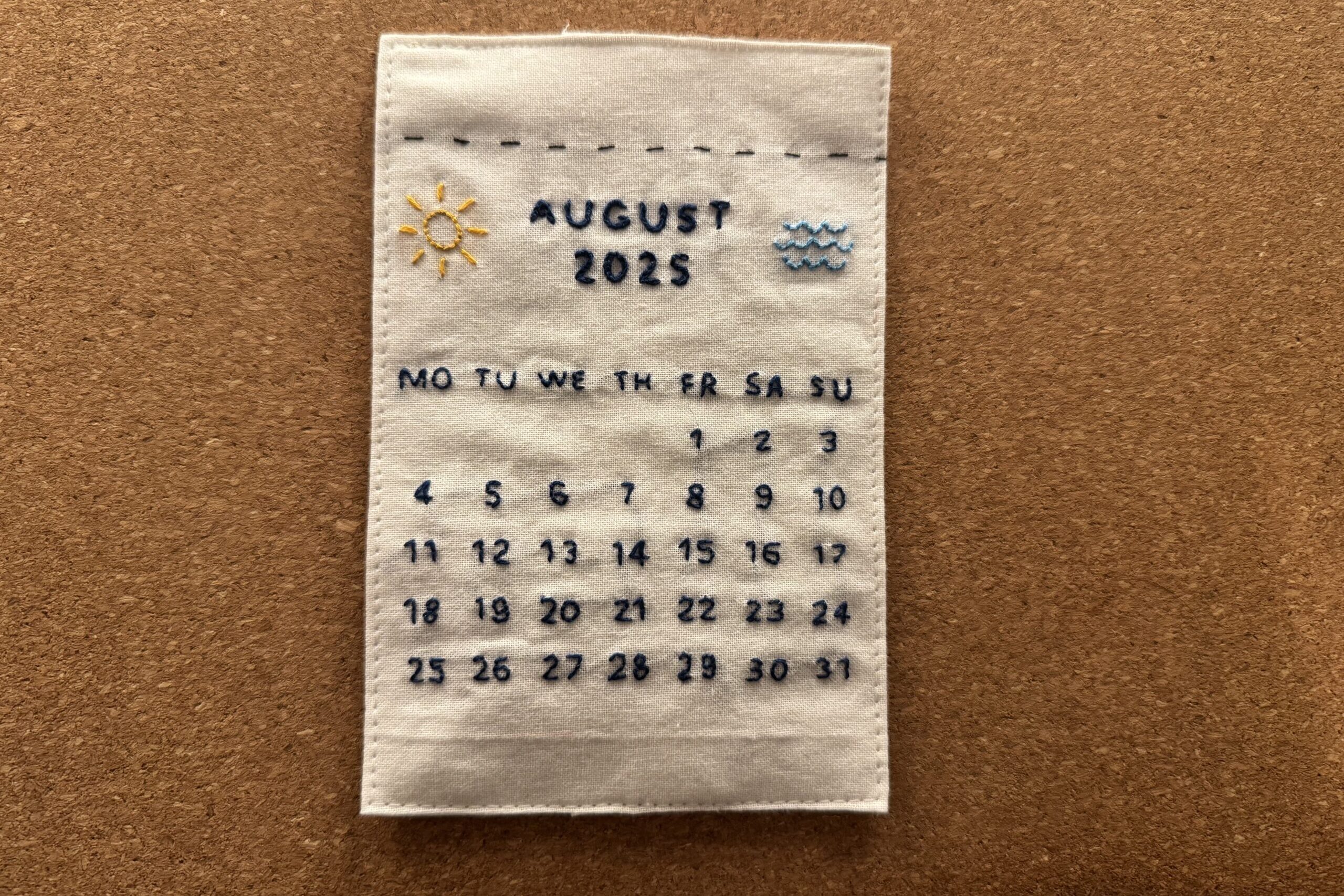
I made College Block Embroidery designs, such as my Pins College Block, but never a Calendar Page. I thought this could be a cute project. The idea is to make one Calendar Page each month for the following month and turn it into a personal tradition. Similar to Clocks, Calendar Pages are no longer essential in offices today, but still serve as beautiful decorations.
The brief I set for myself for this project was to create a Calendar Page that resembles one of those old-school calendars you tear off. I wanted to include each day along with the corresponding weekday. As a decorative element, I wanted to incorporate two symbols that I associate with this month.
The second aspect for me was that it adheres to standard paper sizes. Once all the pieces are cut and sewn to size, the final page should measure 10.5 x 14.8 cm, which is the size of a regular DIN A6 page.
What I liked about this project is, that it was challenging my skills, but not too much. The stitches themselves are not that complicated, but whoever did tiny letters before knows, how hard it can be to keep all the details in very small letters. For the “rip line” at the top, I used a straight stitch out of one strand of black thread. The letters of the month and year are chain stitches with 3 strands. Same for the tiny letters of the days, but with 2 strands. For the symbols, I opted for the good old classic back stitch.
What I liked about this project was that it challenged my skills without being exhausting. The stitches themselves aren’t particularly complicated, but anyone who has worked with tiny letters before knows how hard it can be that the tiny letters stay readable and neat. For the “rip line” at the top, I used a straight stitch made from a single strand of black thread. The letters of the month and year are chain stitches with three strands, while the tiny letters of the days are made with two strands.
A dark blue similar to ink felt right for the letters. For the symbols, I opted for the classic back stitch. I didn’t spend too much time thinking about the colors of the symbols. A gold yellow and a light blue felt right in the moment.
DIN A6 Page
To fulfill my vision of this project, I wanted the Calendar to follow standard page sizes that are common in Central Europe. When measuring and cutting the fabric, I was very careful to keep that in mind. A DIN A6 Page is 10,5 x 14,8 cm (I rounded to 10 x 15cm). The sides are sewn together on the back, and the top and bottom are folded in. This results in a final size of 23 x 18cm, considering a seam allowance of 1,5cm.
The Lettering
My go-to stitch for letters and numbers in any project is the chain stitch. I like this stitch for two reasons. Firstly, is that you get a continuous line without too much texture or unevenness. Secondly, is’s very easy to make curves by shortening the stitches. This is very important to keep a neat and even look and ensuring readability.
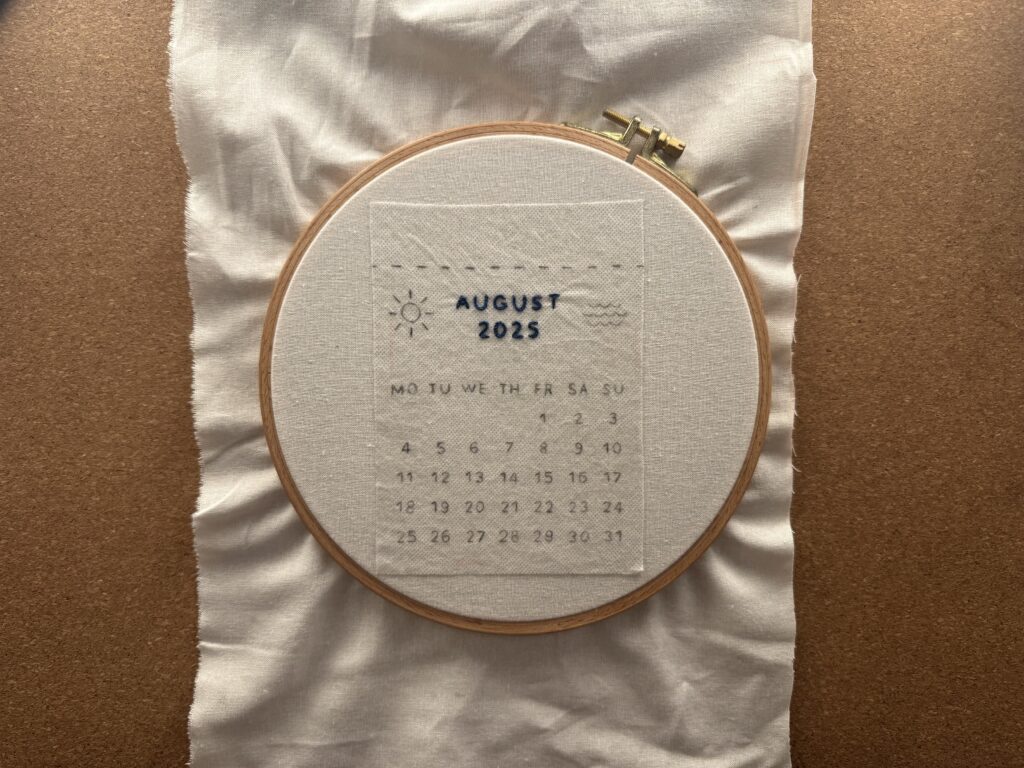
Like every calendar, the month should immediately catch your eye and be easily visible. That’s why I opted for three strands, which is not my usual choice for lettering. The thicker the lines, the more difficult it becomes to read.
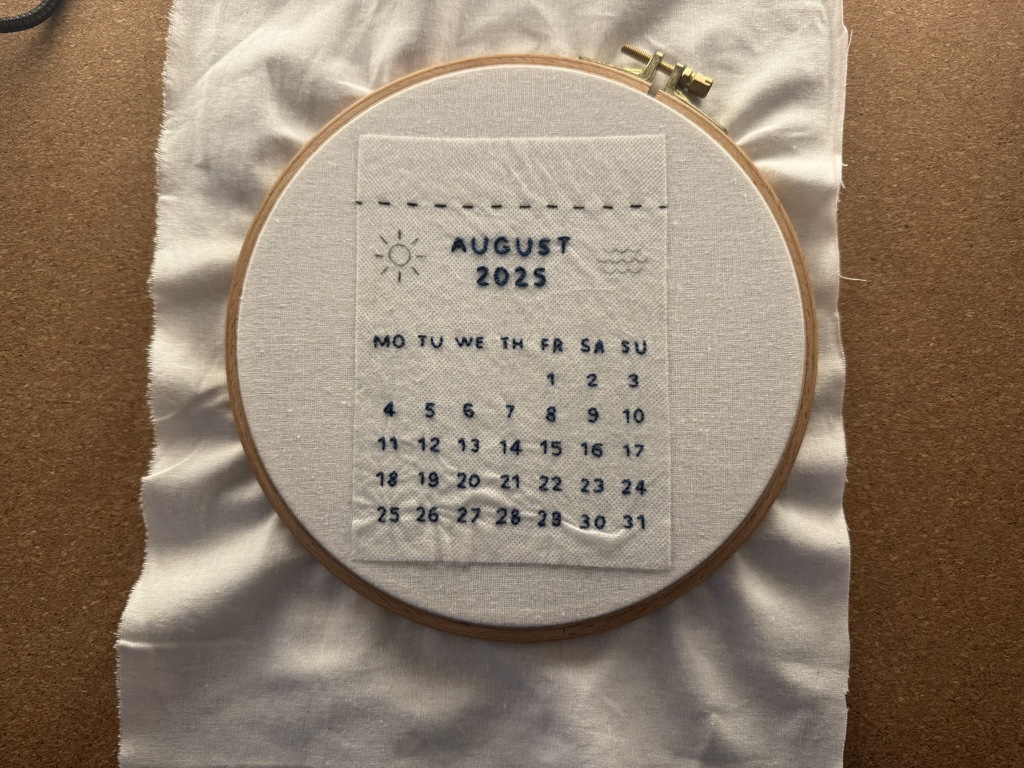
For weekdays, I decided that two strands are better suited. It shouldn’t be the main focal point, and thicker thread means fewer details. The second part is especially important with small letters.
The symbols
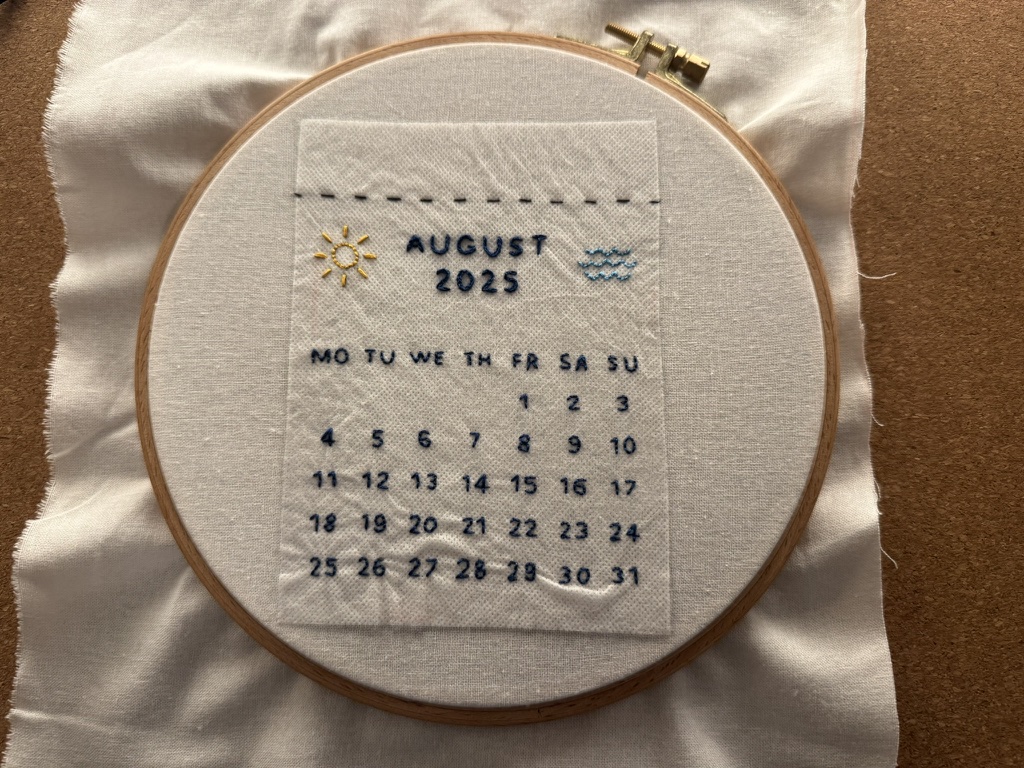
The symbols are the part that brings it all together. I like to keep this part for the end. In my mind, nothing is more symbolic for August than the sun and waves. I usually don’t go beach vacation during August, but nonetheless it is my first association.
This part was done super quickly. Outline doodles are very quick to make in the first place, but because I went with a back stitch without any specials, I was even faster.
After finishing the stitching only the sewing was left. As already mentioned, I folded in the top and bottom and closed the sheet at the back. For the Page to keep shape, I also added end stitched around all edges. This way it stays flat and square and doesn’t warp.